Estimated reading time: 1 minute
Overview
Workforce capacity planning is how organizations match their available people, their skills, hours, and availability, to the actual work on their plate. It goes beyond scheduling. Done well, it gives managers the visibility to shift priorities, take on new projects, and avoid burning out their teams. This article covers how to move from reactive firefighting to proactive capacity management, with practical examples of how teams use Ganttic to get there.
The shift in workforce capacity planning
If someone from the year 2020 arrived today in a time machine, it would likely feel like a totally different world rather than a six year gap.
We have all seen and experienced how the business landscape has undergone a total transformation. We moved from the immediate disruptions of COVID-19 into an era defined by the rapid ascent of AI, global political instability, and a complete reimagining of what a workplace even looks like. The old ways of planning have evaporated.
Uncertainty is the new norm. The standard five year roadmap has been replaced by the need for monthly or even weekly pivots (and for some industries, even daily) as new technologies and global crises emerge. The key (for now, until it changes again) is workforce capacity planning through easy to use, practical, yet custom solutions.
Businesses need flexible systems that can handle remote, hybrid, and in some cases, AI-augmented teams. They should also remain simple enough for a busy resource or project manager to use. When the political or economic ground shifts overnight, your capacity plan must be the tool that allows you to shift with it.
Guesswork can’t be a strategy for workplace capacity planning
Most managers know they are busy, but few can pinpoint exactly where their time is going. Without a clear view of your workforce capacity planning, it is far too easy to drift into autopilot while wasting time, energy, and resources.
This creates a cycle of constant firefighting. You pull people off one project to save another, which eventually causes a ripple effect of delays across the entire portfolio.
According to the PwC 2025 Global Workforce Hopes and Fears Survey, 45 percent of CEOs believe their current workforce setup will not be viable in three years without radical changes to how they plan and deploy talent.
At some point, we needed software allowing us to be more accurate, and to assign resources faster and accessible online. After some research on the web, Ganttic seemed to cover our needs.
Fred Lavenaire, the Head of Bus and Light Railway, RATP Group’s Development Agency

Why traditional scheduling fails in 2026
A schedule tells you what is happening on Thursday 10:00 AM. Capacity planning lets you see if you can handle a new project starting next month. The reason most teams struggle is that they treat these as the same thing. They use static spreadsheets that are out of date the moment they are saved.
Traditional tools and spreadsheets often miss the human element. They fail to track vacation time, varying skill sets, or the inevitable admin lag that eats into a 40 hour work week. When you ignore these variables, your capacity looks higher on paper than it is in reality. You end up overpromising to stakeholders and underdelivering because your team is physically unable to keep up with the volume.
The capabilities of Ganttic to overlay project needs, assign resources, and collectively display company-wide actions is exactly what we had been looking for. We have been able to stop using both CoConstruct and Google Calendar for scheduling purposes.
Joshua Rowland, Assistant Superintendent at G. Christianson Construction
If your planning tool cannot show you true availability across the whole organization in real time, you are making decisions on bad data.
Ganttic provides a smarter, clearer, and easier way to manage your resources, replacing the chaos of spreadsheets with real-time visibility. Find out more here:
Looking for a Spreadsheet Alternative? Here’s How Ganttic Compares
Strategic workplace capacity planning: the three pillars
To achieve true agility or, from another angle, business flexibility and resilience, you must look at your resources through three distinct lenses.
1. The availability lens
You need to know who is actually available to work. In a global or hybrid workforce, this is complex. You have to account for different time zones, regional holidays, and part-time contracts. Without an accurate view of true availability, your planning starts on a foundation of bad data.
In practice: Sunstall, a solar installation company managing crews across multiple job sites, needed a single source of truth for who was on-site, when, and where. With Ganttic, different people from across the company can check the same up-to-date view of resource availability — no more duplicate bookings, no more surprises on-site. As co-founder and CEO Helge Biernath put it: “Different people from all over the company can look from different angles and get the most up to date information about their job.”
2. The skill set lens
Capacity involves more than just a headcount. It relies on specific capabilities. Mapping your team’s skills allows you to see where you have a surplus and where you are vulnerable to bottlenecks. A project does not just need a person; it needs a person with the right expertise at the right time.
In practice: Q Agency, a software development consultancy, needed to know at a glance which developers were between projects and which technical profiles were available for incoming work. Resourcing coordination expert Marija Donkov describes how they use Ganttic: “Ganttic for us, is a big database for keeping all that data in one place and a way to see who is currently on bench for the next project.”
By tagging resources with their tech stacks and seniority levels, Q Agency can make allocation decisions in minutes rather than days.
3. The demand lens
This includes current projects, maintenance tasks, and shadow work like internal meetings. By plotting this demand against your availability, you can see the gap. That gap represents your agility. It shows you exactly how much room you have to pivot when new opportunities or crises arise.
In practice: Dribia, a data science consultancy, was growing rapidly and needed to see not just current commitments but future demand before hiring decisions became urgent. Co-Founder Oleguer Sagarra explains: “Today we’re 20 people, but tomorrow we might be 50. We needed a clear plan of what was coming next.” By visualizing upcoming project demand in Ganttic, Dribia could make informed hiring and allocation decisions ahead of time, rather than scrambling to backfill after signing new contracts.
How Ganttic supports workplace capacity planning – more about features
Ganttic acts as the live operational layer between your strategy and your daily tasks. It gives you clarity so that you can make better business decisions. Instead of a flat list in a rigid structure, it provides a multi-dimensional view of your organization.
In Ganttic, everything starts with a Resource. This can be people, equipment, facilities, or anything else that needs to be scheduled.
Customization via Data Fields for Resources, Tasks, and Projects
Our motto is “Every business is different, and so is their Ganttic.” The platform allows you to build a system that fits your specific workflow through custom Data Fields. You can track anything from a technician’s specific certification to a developer’s preferred programming language. This makes it easy to filter for the most relevant talent and background when assigning your tasks and projects.
Utilization and web-based, real-time visual feedback
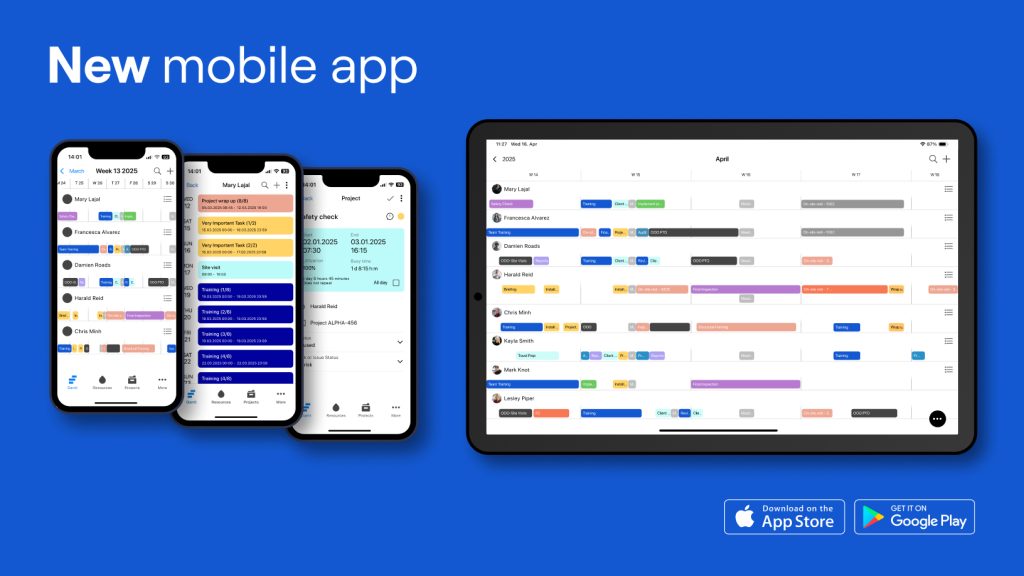
Ganttic is a web-based resource planner with a mobile app, so you can see your schedule on the go. Since our pricing is based on resources, you can invite as many users, collaborators, or viewers as you need. This keeps everyone on the same page thanks to a synchronized, real-time view.
Drag-and-drop scheduling
When plans change (and they will) Ganttic’s drag-and-drop interface lets managers reallocate tasks and update timelines in seconds. This is the operational speed that makes proactive capacity management practical rather than theoretical.
Holidays and time off
Ganttic accounts for the variables that spreadsheets routinely ignore: public holidays, PTO, and part-time schedules. Teams can reflect their plans and availability on their timeline in Ganttic.
Moving from reactive to proactive
Agility is often misunderstood as moving fast. In reality, agility is the ability to change direction without losing momentum. You cannot do that if your resources are already maxed out.
Proactive capacity planning involves looking ahead to make informed hiring decisions rather than panic-hiring when a project is already late. It also gives you the data needed to say no to projects that would jeopardize your existing commitments.
When you use Ganttic to track utilization rates, you start to see patterns. You might notice that your design team stays at 95 percent capacity while your QA team sits at 60 percent. With that data, you can adjust your pipelines or cross-train staff to balance the load.
After I started using Ganttic, for the first time ever, I was able to send our client a roadmap of their possible projects for the year.
Joe Jenkins, Digital Resourcer, DRP Group
That shift, from reactive firefighting to forward-looking planning, is what workplace capacity planning actually delivers.
The bottom line
Workforce capacity planning is the difference between a team that is constantly stressed and one that is performing at its peak. By defining your availability, mapping your skills, and visualizing your demand, you create a buffer for uncertainty.
Ganttic provides the visibility needed to manage this balance. It turns your workforce into a transparent, manageable asset rather than a series of unknowns. When you know exactly what your team can handle, you can stop guessing and start actually delivering.
FAQ
Workplace capacity planning is the process of matching your team’s available time and skills to the work your organization needs to deliver. It helps managers see, in advance, whether they have enough of the right people to take on current and future projects.
Scheduling tells you who is doing what on a given day. Capacity planning tells you whether your team can realistically handle the workload over the coming weeks and months. One is operational, the other is strategic.
Without it, teams tend to end up in a cycle of last-minute reshuffling. Projects get delayed, people get overloaded, and managers are constantly reacting instead of leading. Over time it affects both delivery quality and staff morale.
Start by mapping your available hours across your team, then plot your current and upcoming project demand against that with a resource scheduling tool like Ganttic. Even a rough version of this will surface gaps and conflicts you did not know existed. From there, you can decide what level of tooling you need.
For most teams, a monthly review is a minimum. In faster-moving environments, weekly check-ins are more practical. The goal is to catch imbalances before they become problems.
Want to have a clearer picture of your workplace capacity?
Written by
Gökçe Karabay
Marketing Lead at Ganttic