Overview
Engineering scheduling requires a unified, real-time view of specialized labor, heavy machinery, and facility availability to prevent project bottlenecks across a complex portfolio. Ganttic addresses this by centralizing these dependencies onto a shared timeline, allowing managers to pair certified specialists with specific equipment while accounting for shifting site visits and maintenance cycles. In an industry where physical assets are as critical as human expertise and schedules are subject to ripple effects from permitting or weather delays, the software uses custom data fields to track niche skills and regional constraints to ensure high-value resources are never left idle or double-booked. This system-wide transparency enables civil engineering firms and R&D labs to move from reactive scheduling to proactive capacity management, maintaining operational control and regulatory compliance as project volumes scale.
When you’re managing multiple engineering projects simultaneously, scheduling becomes more about maintaining control. Resources can get double-booked. Equipment may sit idle in one location while teams wait for it elsewhere. Without a dedicated planner, critical specialists can end up committed to three different projects in the same week. Ganttic helps engineering teams schedule people, equipment, and facilities using custom data, making capacity visible across the entire operation, not just within individual projects.
Most engineering teams juggle multiple builds, site visits, testing phases, and maintenance cycles at once. As operations expand, scheduling stops being a coordination task and becomes a systems challenge. Interdependencies between people, equipment, certifications, and shifting timelines demand a single, reliable view of capacity.
When engineering scheduling outgrows spreadsheets
Spreadsheets work fine when you’re managing a small team with a handful of shared assets and minimal overlap. But as your project portfolio grows, scheduling complexity compounds faster than your tools can keep up.
The breaking point usually hits when:
- The same specialist is needed across multiple concurrent projects
- Critical equipment must be shared between sites
- Certifications determine who can perform specific tasks
- Project timelines frequently shift
- Resource data is scattered across separate systems
At this stage, managers spend more time verifying availability than actually planning. You’re checking one spreadsheet for people, another system for equipment, maybe a third tool for project timelines. None of these sources talk to each other or reflect real-time status.
The result? Conflicts surface late. A site inspection gets scheduled, then you discover the required testing unit is already allocated elsewhere. A certified engineer appears on two different project plans because separate teams updated separate files. Equipment maintenance wasn’t factored into anyone’s timeline.
These small coordination gaps compound quickly, turning into budget overruns and timeline extensions. Ganttic prevents this by centralizing resource data in one platform where teams can see real-time allocation across all projects. Teams can handle resource scheduling and project portfolio management having crystal-clear view of availability and deliverability across their organization.
Learn more about how Ganttic helps engineering teams in their resource planning processes!
Engineering resource scheduling 101:
4 things engineering teams need to see simultaneously
Reliable engineering scheduling requires answering four questions at once:
- Who’s available?
- Who has the right certifications?
- What equipment can we use?
- How do existing commitments affect our capacity?
This information can’t live in separate project plans. It needs to span all active work. Otherwise, you only spot conflicts after they’ve already caused problems.
Ganttic consolidates this into one Gantt-based planning environment where people, equipment, and facilities appear on the same timeline. You can toggle between resource views (How is this engineer allocated across projects?) and project views (How is this build staffed and equipped?) to understand both granular allocation and overall capacity before committing to new work.

For organizations managing dozens of engineers, vehicles, machines, or sites, this dual perspective becomes essential. Ganttic supports large resource pools and lets you define custom data fields including certifications, roles, locations, equipment types, so you can filter and plan based on how your operation actually works, not generic categories.
This matters particularly in engineering environments where physical assets are as critical as human expertise. When a project requires a specific crane and a certified operator, you need to see both constraints in the same place.
Matching capabilities to tasks under real constraints
Engineering scheduling is about pairing the right capabilities with the right tasks while accounting for real-world limitations.
Certain equipment requires certified operators. Some specialists have niche expertise needed only during specific build phases. Equipment may be restricted to particular regions. Maintenance windows reduce availability. Permitting delays shift everything downstream.
Ganttic allows teams to attach custom fields to resources such as certifications, roles, equipment categories, site locations. These attributes become filters when you’re planning, so you can quickly identify:
- Engineers with a specific certification
- Equipment available at a particular site
- Resources with capacity during a defined time frame
This structured approach reduces the risk of non-compliant assignments and last-minute scrambling.
See how Ganttic supports skill management by letting you create and structure resources using Data Fields:
How different engineering teams use Ganttic
Scheduling challenges vary significantly depending on the type of engineering work. The assets involved, the regulatory environment, and the project structure all shape what teams need from their planning tools.
Civil Engineering
Civil projects typically span multiple locations. Teams operate on different sites, equipment moves between regions, and weather or permitting delays can reshape timelines without warning.
Ganttic gives civil engineering teams a real-time view of who’s allocated to which site, where equipment is currently deployed, and which resources meet specific regional or certification requirements. When delays occur (and they will) teams can adjust timelines visually without hunting through disconnected files.
Because everything lives on a shared Gantt timeline, geographic complexity doesn’t fracture your planning process.
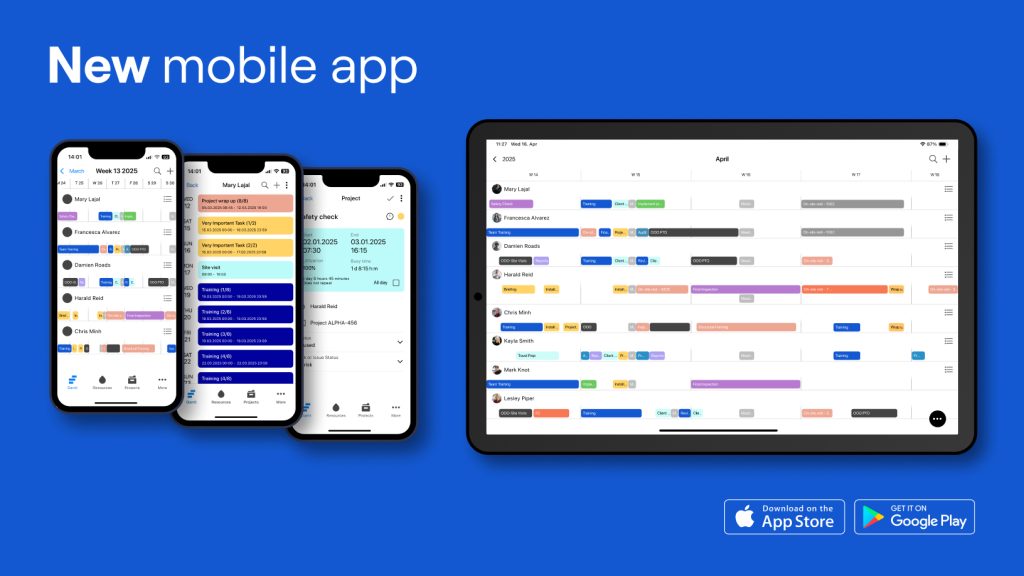
The Ganttic Planner mobile app is updated! Easier navigation, single Project Gantt view and more. Find out more about the new features in the new Ganttic mobile planner.
Engineering Services
Engineering services firms often run dense schedules packed with site visits, inspections, consultations, and overlapping short-term projects. Utilization directly affects revenue, so precision matters.
A missed overlap or double-booked consultant both disrupts delivery and cuts into profitability.
Ganttic helps these teams plan site visits with clear time allocations, manage multiple projects of varying durations simultaneously, monitor workload distribution, and prevent accidental overbooking. The platform handles the volume while keeping individual schedules visible.
Labs and R&D
In research environments, scheduling must account for shared equipment, limited lab capacity, and the tension between confirmed projects and tentative experiments.
Future tests often require provisional equipment allocation before they’re finalized. Without a structured way to distinguish between confirmed and tentative work, teams risk accidentally blocking confirmed projects with speculative plans or worse, overbooking critical instruments.
Ganttic lets labs prevent equipment conflicts, differentiate between confirmed and tentative allocations, optimize utilization of specialized assets, and maintain control when planning becomes layered with uncertainty.
Custom data fields allow teams to categorize and filter resources according to experimental needs, equipment capabilities, or project phases.
Maintaining clarity as you scale
Growth multiplies scheduling complexity. More engineers, more equipment, more sites, more overlapping deadlines. What worked for twenty people doesn’t work for two hundred.
Ganttic supports large resource pools without sacrificing clarity. Custom fields, filtering options, and segmented views help managers navigate hundreds of resources without losing track of individual allocations or overall capacity constraints.
See how Ganttic can bring clarity to your engineering scheduling and day-to-day operations:
– Start a free 14-day trial, no credit card required, and explore the platform at your own pace
– Or book a demo if you would rather walk through it together and see how it fits your team’s workflow!