Estimated reading time: 8 minutes
Overview
Resource management in 2026 has shifted from a static administrative task to a strategic orchestration of people, equipment, and digital assets. As planning cycles shorten, the ability to make data-driven decisions based on real-time availability has become more critical than long-term forecasting. Ganttic addresses this evolution by centralizing these diverse resources into a single integrated ecosystem that connects seamlessly with existing tools like Google Calendar and Outlook. By focusing on immediate capacity visibility and human-led judgment over total reliance on AI automation, the platform ensures that complex organizations across engineering and R&D can bridge the gap between strategic vision and actual operational capabilities while maintaining full control over shifting project demands.
2026 agenda: long-term predictions or smarter decisions
2025 taught a lot of teams an uncomfortable truth: your quarterly plan looks great until Tuesday (and today is Monday). We watched companies with solid strategies scramble because their planning cycles couldn’t keep up with how fast things actually moved on the ground. So will it be even more challenging for businesses in 2026?
2026 isn’t about predicting the next six months anymore. It’s about making smarter decisions with what you have right now.
We’ve spent the last year watching companies navigate economic uncertainty. Here’s what we noticed: the ones succeeding aren’t necessarily throwing more resources at problems.
They’re getting better at using what they already have. If you’re still treating resources like a static list to check off, you’re constantly playing catch-up. That’s where resource management stops being just a planning exercise and becomes a strategic tool.
Want to learn more about how resource management can help your business? Here is your guide: Resource Planning: A Guide for Efficiency
The themes that stand out in 2026 are:
- ‘right now’ beating ‘the next 6 months’
- the changing role of resource management
- integrations as being more important than ever
- clearer definition of what a resource is
- AI-powered tools and features (surprise)
From administrative task to strategic orchestration
For years, resource management meant maintaining spreadsheets and assigning people to projects. By 2026, that approach doesn’t work anymore.
What does work? Treating your resources (people, equipment, rooms, anyone and anything that can be scheduled and booked) as a system that needs coordination across your entire organization, not just within individual projects.
Instead of rigidly assigning “Sarah to Project X,” you’re thinking about how Sarah’s expertise fits into three concurrent projects, when the testing equipment she needs will be available, and whether the timeline makes sense given your other commitments.
If you’re scheduling equipment, you will need to see both their availability and the downtime. This will enable you to assess your company’s actual resource needs. Relevant team members will need to be aware of this too.
This is what we call resource orchestration. It’s seeing the big picture and creating a rhythm where different departments communicate through data instead of last-minute Slack messages or email loops.
How Ganttic can help
Companies still managing resources in static lists hit a wall when demand shifts faster than they can replan. Ganttic’s resource and project views let you switch instantly, so you can see who’s available and what needs doing.
That way you can create more powerful views, whether it’s a Resource view, a Project view or a custom view. More than an alternative to spreadsheet planning, Ganttic helps you show your workflow from different perspectives so that you can make relevant, timely, and smarter decisions.
Integration: The real competitive advantage
Tools are great as long as they solve our problem. When setting up the tool takes longer than doing the actual work, the tool itself has become the bottleneck adding a second problem to the list.
In 2026, businesses are demanding systems that actually talk to each other. The planning tools that win won’t be the ones with the most features. They’ll be the ones that integrate seamlessly with everything else you’re already using.
The less manual syncing you’re doing between systems, the more time you have for actual planning.
How Ganttic can help
When it comes to integrations, Ganttic connects with tools teams already rely on, including Google Calendar, Outlook, and Zapier. This allows planning to stay in sync with what’s happening elsewhere, without constant manual updates or duplicated work.
Redefining “resource” in 2026
What counts as a resource is changing.
Teams already blend human creativity with automated processes and AI assistants. A “resource” in 2026 might be your senior engineer, or it might be the automated testing suite that runs overnight, or it might be the AI tool that delivers a first-draft.
And it’s not just a niche trend. According to the 2025 Gallup report, AI and digital tools are rapidly becoming central to how work gets done, with about 45% of employees using AI at least a few times a year to boost productivity and efficiency.
How Ganttic can help
When you’re scheduling resources in Ganttic, you’re not just booking people. You’re coordinating an entire ecosystem of capabilities.
Our role at Ganttic has shifted with this reality. We’re focused on making this collaboration work in practice by providing an environment where human expertise and automated processes can be planned and managed together. You need visibility into both.
Who actually needs AI (and who doesn’t) for resource management in 2026
2025 was the year AI dominated every boardroom conversation and vendor pitch. The capabilities are impressive, no question. But we’ve noticed companies are often asking the wrong question.
Instead of “How do we implement AI?” try asking “What specific problem are we solving, and is AI the right tool for it?”
There’s a difference between adopting AI to solve a real operational challenge and adopting it because everyone else seems to be. The latter is expensive FOMO dressed up as strategy.
Technology earns its place on your stack when it solves a real, measurable problem. When it doesn’t, it becomes another system your team has to maintain, another login to remember, another budget line item that no one can quite justify.
Automation handles certain things remarkably well: processing large datasets, running repetitive tasks at scale, flagging patterns across thousands of data points.
Where it falls short is exactly where planning gets complex. Responding to sudden changes, working with incomplete information, making decisions that require weighing context and real-world consequences. These judgment calls still require human insight and experience.

How Ganttic can help
Our approach isn’t about replacing that judgment. It’s about supporting it with better information and clarity.
Ganttic gives teams a clear, real-time view of their operations so decisions get made based on understanding of capacity, availability, and constraints, not guesswork or blind faith in what an algorithm recommends. You stay in control. The system shows you what you’re working with so you can make the call that makes sense for your situation.
As a capacity planning tool, Ganttic shows you at a glance where you’re approaching bottlenecks or where you have unused capacity. You and your team stay in control. The system shows you what you’re working with so you can make the call that makes sense for your situation.
Want to see how this works for your team? Book a demo and we’ll walk you through it.
2025 in Review: What We Learned at Ganttic
Last year forced a lot of us to rethink what growth actually means. Real, sustainable growth isn’t just about speed. It’s about understanding your capacity and performing within it.
During a year of market corrections and economic uncertainty, resilience became the metric that actually mattered. For the Ganttic team too.
- We welcomed over 150 new clients in 2025, spanning architecture, engineering, ICT, and construction.
- We welcomed new team members for different roles including sales, marketing, and development.
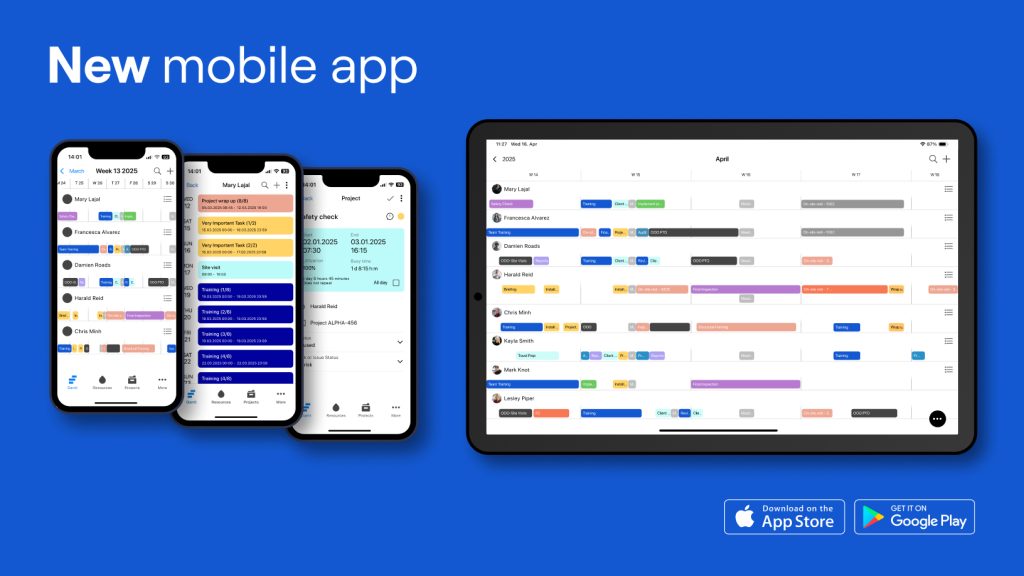
- We released the Ganttic mobile planner app at the end of 2025. When you have to be on-site and need to make real-time scheduling decisions, you shouldn’t have to wait until you’re back at the office to update the plan.
What We’re Focused on in 2026
Our priority this year is redesigning the Ganttic interface to make the transition between resource and project perspectives even more intuitive.
At Ganttic, our goal is to show you a clear picture of your resources and projects, whether you want to plan resources at an engineering company coordinating specialized technicians with many equipment across multiple job sites, managing a large consulting firm, or handle resource planning at a company in environmental services.
At the end of the day, what matters is having a clear workflow that helps you see the big picture, anticipate issues, and recognize potential.
Planning the unplannable with resource management in 2026
Trends come and go. The fundamental challenge remains the same: bridging the gap between your vision and your actual resources.
In our experience, the companies that thrive aren’t necessarily the ones with the deepest pockets. They’re the ones with the clearest view of their own capabilities who can do what, when they’re available, what equipment or skills are required, and how everything fits together.
2026 will bring surprises. It always does. But when you have a clear view of your operations, those surprises become opportunities rather than crises.
That’s what we’ve built at Ganttic: a clear window into your current capacity and future needs. Making better decisions with today’s information beats having a perfect plan for a future that never quite materializes.
Discover how Ganttic can give you better visibility into your operations:
- Start a free 14-day trial (no credit card required) to see how it works for your team and explore on your own time.
- Book a demo to see if you’d prefer a guided walkthrough.
Written by
Gökçe Karabay
Marketing Lead at Ganttic