Can I create a Gantt chart in Outlook?
Outlook does not support Gantt charts natively. While Microsoft offers a manual workaround, the process requires building complex Excel spreadsheets from scratch. Forcing a calendar into a Gantt format is possible if you have the time to maintain it, though integrating a dedicated scheduling tool provides a much more efficient solution.
How do I create a Gantt chart for my calendar?
Integrating an online Gantt chart with your calendar transforms standard Outlook events into a dynamic visual timeline. Managers can sync their entire team’s individual Outlook calendars into a single Gantt chart. This coordinates all internal staff, project teams, and external freelancers within one centralized resource plan, providing total clarity on who is doing what and when.
Why use Ganttic to create an Outlook Gantt chart?
When you sync Ganttic with Outlook., you get a clear view of your project’s timeline right alongside your daily calendar. This integration makes managing multiple tasks and deadlines much easier. Plus, you’ll be able to visualize resources, dependencies, and critical milestones, which standard Outlook doesn’t offer. it is also the easiest way to use Gantt chart scheduling in Outlook Calendar.
Here’s how it benefits your project management:
- Visual timelines: Unlike traditional Outlook scheduling, a Gantt chart provides a visual representation of your tasks, showing overlapping activities and dependencies.
- Real-time updates: Syncing ensures your calendar is always up to date with any changes made in Ganttic.
- A single source of truth: By syncing Ganttic with Outlook, your team gets a unified calendar where everyone stays on the same page. Learn more about managing shared team calendars.
- Better availability tracking: Instead of juggling multiple calendars, Ganttic helps you see who’s available and when, preventing scheduling conflicts and overbooking.
Creating an Outlook Gantt chart with Ganttic
Setting up an Outlook Gantt Chart with Ganttic is quick and easy. First, you’ll need a Ganttic account and access to your Outlook Calendar. Once connected, Ganttic will sync your project tasks with Outlook, keeping everything updated automatically.
Watch the video here on how to make it happen:
Or follow these steps:
1. Sign up for Ganttic: If you haven’t already, create a free Ganttic account.
2. Add Resources: These are your team members whose Calendars will be synced. You can add resources manually, watch the tutorial below, or upload your entire resource pool via CSV import.
3. Enable calendar sync: Sync the calendars of team members whose schedules you want to manage. Click the calendar synchronization icon in the toolbar and select Outlook Calendar.

4. Choose your sync direction:
- One-way sync: Ideal if you only want Outlook events to appear in Ganttic without sending data back to Outlook.
- Two-way sync: Keeps both calendars in sync, so updates in Ganttic reflect in Outlook and vice versa.
5. Customize sync settings: Decide what information gets transferred. Outlook event titles will become Ganttic task names, while Ganttic task and project names will appear as Outlook event titles.
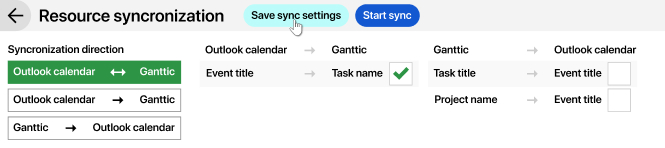
6. Start the Sync: Click Save Sync Settings, then Start Sync.
7. Authorize Ganttic: A pop-up will ask for permission to access your Outlook Calendar. Click Yes.
8. Select Your Calendar: Choose which Outlook Calendar to sync with Ganttic.

Once everything is set up, your Outlook Gantt Chart will stay updated in real time. You’ll receive notifications when tasks start, end, or change—just like any other event in your calendar. Now, you’re all set to manage your projects visually while keeping Outlook in sync.
Tip: In addition to Outlook sync, did you know you can also sync Ganttic with your GCal?
Benefits of an Outlook Gantt chart integration
There are a number of benefits as to why you should sync your Gantt chart and Outlook, including:
Easier than creating a Gantt chart in Outlook
Syncing your scheduling software directly with Outlook takes seconds and seamlessly connects your project data with your personal calendar. This automated integration is significantly more efficient than attempting to build a manual Gantt chart using complex Excel workarounds. By connecting the tools directly, you eliminate tedious administrative setup and ensure your schedule remains perfectly accurate.
Perfect for managing dispersed teams & freelancers
Tracking freelancer schedules across different time zones or concurrent projects requires precise coordination. With Ganttic’s Outlook sync, any tasks, updates, or deadlines you schedule automatically appear in their personal calendars. This eliminates the need for constant check-ins, as external contractors simply open their native Outlook app to view their upcoming assignments.
This automated synchronization is equally effective for managing remote workers and hybrid teams, allowing you to focus on project execution rather than administrative logistics.
Introducing new software often creates an adoption barrier for less technical team members or external stakeholders. Syncing your planner with Outlook bypasses this learning curve entirely. By delivering project updates directly to a familiar environment, you guarantee that everyone stays informed on critical work events.
Anyone with access to the shared calendar can view upcoming task assignments and deadlines without ever logging into Ganttic.
More control
Synchronizing your calendar with your planner gives you complete control over the data shared between platforms.
Ganttic allows you to select specific resources for synchronization and dictate the exact flow of information. You can configure a one-way sync to push updates from your planner directly to Outlook, or choose a two-way sync to ensure new events and schedule changes automatically populate across both systems.
Using Outlook as a native Gantt chart forces a basic calendar to perform complex project management tasks it was not built to handle. Syncing Outlook with Ganttic allows you to use both platforms for their optimal purposes.
By customizing your sync settings, you can keep Outlook dedicated to standard appointments while reserving Ganttic for robust resource planning. Alternatively, you can fully integrate the systems to ensure schedule changes automatically reflect across both platforms, guaranteeing you always use the right tool for the right task.
Sync your plans effectively
Syncing your personal calendar with Ganttic is a quick way to get organized and stay on top of your plans. It’s an easy way to make clear online Gantt charts shareable with the whole team.
You can also do the same if you’re using Google Calendar. Or if you’re interested in syncing your in-house applications instead, Ganttic API is also available. However you sync, try it today and schedule your resources better for tomorrow.
Want to keep your team better connected?