Quick Answer
AI-powered resource management uses machine learning to automate scheduling and capacity planning by predicting task durations and matching skills to projects. While effective for high-volume, standardized workflows like logistics and IT, these tools often fail in specialized fields like engineering and construction where human judgment is vital. Without a clear underlying process, AI simply automates organizational chaos; therefore, complex industries are better served by visual planning tools that prioritize human-led decision-making and transparency over black-box algorithms.
Getting Started: AI-powered resource management as the latest frontier
The current enterprise landscape is starting to reflect the influence of AI. It is appearing more frequently across various software solutions, including new tools for AI-powered resource management. While the technology is impressive, does every organization need it right now?
In the world of operations, AI-powered resource management is the latest frontier. It promises to take the headache out of scheduling, project allocation, and capacity planning. However, many buyers are currently being sold high-tech features they do not fully understand, may not actually be ready to implement or may not need at all.
Before investing in an AI-heavy tool, it is worth pulling back the curtain. Does adding an AI layer to a broken planning process fix the underlying problem, or does it just automate the chaos?
Defining AI-powered resource management: does your team need it?
At its core, this technology uses machine learning to assist managers in distributing work across a team. While traditional resource management relies on manual entry and human oversight, AI introduces several specific capabilities:
- Predictive Analytics: The system looks at historical project data to estimate how long future tasks will take and which resources are likely to go over budget.
- Smart Assigning: Based on skill tags and current availability, the software suggests the most qualified person for a specific task.
- Scenario Modeling: This allows you to run several what-if simulations. You can instantly model the impact on your entire portfolio if you take on a new contract or lose a key team member.
- Risk Flagging: Instead of a manager spotting a conflict on a Gantt chart, the system flags potential burnout or deadline clashes before they occur.
These features represent a massive leap forward, but they come with a significant caveat: software is an amplifier, not a cure. AI can optimize for efficiency, but only humans can optimize for morale and long-term retention.
The trap of automating chaos
A common misconception in the tech world is that a new tool can fix a cultural or process-based issue. If your team currently lacks a clear workflow, or if project scopes shift constantly without documentation, AI will struggle to provide value.
If you feed disorganized processes into a smart algorithm, the system may simply automate the chaos. It is likely to give you highly confident, incredibly fast, but ultimately incorrect predictions. This creates a cycle where flawed data leads to wrong decisions, which then feeds back into the loop.
Effective resource management requires a foundation of high-quality data and a culture of transparency. If your team does not have visibility into its own capacity today, an AI layer will be like putting a high-performance engine into a car with no steering wheel.
Data integrity and human judgment
At Ganttic, our vision for planning centers on clarity. We recognize that AI is a powerful tool, but it should remain secondary to data integrity and human judgment.
Why data matters first
AI learns from patterns. If a project manager consistently forgets to log buffer time between tasks, the system will assume no buffer is needed. It may then optimize your team to 100% capacity, leading to immediate burnout. For these tools to work, the underlying data must be an honest reflection of reality.
In Ganttic, you can build that honest foundation. Customizable Data Fields let you capture everything that matters -buffer time, capacity limits, project context- so your plans reflect reality, not just what looks good on paper. When the data is right, decisions follow. And those decisions stay in human hands.
Watch the video to learn how to create Resources and fill in Data Fields in Ganttic.
The value of the human element
Automation is excellent for handling the mundane: calculating hours, checking for double bookings, or syncing calendars. However, human judgment is required when things get complicated.
A manager knows when a team member has just finished a grueling project and needs a low-stakes week to recharge. A manager understands the subtle interpersonal dynamics between a client and a staff member. AI can optimize for efficiency, but only humans can optimize for morale and long-term retention.
How Ganttic bridges the gap
We often see companies looking for an AI fix when what they actually need is a clarity and workflow fix. In Ganttic, we solve the problem of chaos by focusing on the foundation of the planning hierarchy.
The shift toward AI is inevitable, but the tech is only as good as the foundation it sits on. Businesses need to make sure their data is clean and their resources are fully mapped out before leaning into it. It’s a simple equation: if the underlying process has lots of issues, AI is just going to automate them. That’s why prioritizing visibility is more important than jumping straight into automation and predictions.
Rainer Kivimaa, CTO of Ganttic
Building the single source of truth
AI is great, and no need to discuss how it is -and will- change our lives and businesses. That said, before you can ask a machine to help you plan, you need to know what you actually have.
In Ganttic, we make it easy to centralize every Resource, Project, and Task in one place and create a visual environment where everyone can see the same timeline.
Flexible modeling over rigid automation
In Ganttic, we do not believe in forcing you into a black box where an algorithm decides your team’s fate.
Instead, we provide the tools for human-led scenario planning. As mentioned earlier, our flexible custom Data Fields allow you to track the nuances that matter to your specific industry, such as certification levels, equipment locations, or regional holidays. This ensures that when you do use automation, it is working with a full, accurate picture of your world.
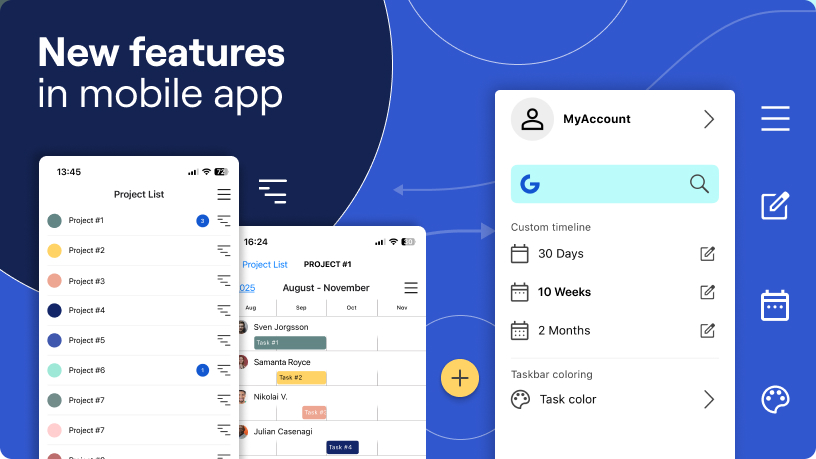
On-the-go accountability
A plan is only as good as the information coming back from the field.
Our mobile planner is designed to bridge the gap between the office and the front line. When your team can update their status or add notes in real-time, the data stays fresh.
Find out more about the Ganttic Mobile App and its features: Ganttic Planner Mobile App – New Features
The pressure to adopt new technology is high, but the ideal level of automation depends entirely on the nature of the work.
Where algorithmic automation excels
In sectors like massive-scale logistics, high-volume IT support, or predictive manufacturing, success often depends on processing thousands of standardized variables.
In these environments, AI-powered scheduling can be helpful in managing the sheer volume of data, such as routing parts or triaging technical tickets, where tasks are highly repetitive and uniform. But there should already be a system in place for AI to learn from and build on.
Where human-led planning takes center stage
For many of the industries we serve at Ganttic, including complex engineering firms, construction companies, creative agencies, and specialized consultancies, the work is far from standardized.
In these fields, a resource can be a unique human talent with a specific creative style, a decade of niche experience, or a particular way of solving a problem or equipment with particular features.
In these contexts, the goal isn’t to have a machine auto-assign a task. Instead, these teams find the most success with visual clarity.
They need a clear, bird’s-eye view of their capacity so that a human manager can make the final, nuanced decision. For these experts, the real value isn’t in a black-box algorithm, but in a flexible tool that provides the visibility needed to lead a high-performing team.
Visibility is the intelligence you can build on
Times are changing, and when we say change, we mean almost every day: from the political landscape to the economy and business. From this perspective, we believe the most effective thing a company can do is achieve total visibility, meet today’s challenges head-on, and adapt to the unexpected.
Our approach focuses on giving you a clear and flexible way to see your resources, tasks, and projects. Whether you are using a mobile app for quick updates or planning a multi-year project on the web, the goal is a single source of truth.
While AI is undeniably transformative, the most successful teams are those where managers stay connected to their team’s actual capacity. Automation can remove the friction of manual work, such as syncing data or flagging overlaps in highly repetitive operations, but the strategic mind of the company should remain human.
Before you invest in the hype, invest in your process. Get your data in order and ensure your team has a culture of transparency. Once you have a clear, visual understanding of your capacity, you will be in the perfect position to decide if you truly need AI to manage it.
Written by
Gökçe Karabay
Marketing Lead at Ganttic