How Ganttic solved equipment utilization at Pure Technologies
Pure Technologies inspects and monitors critical infrastructure, mostly large pipelines, using technology it patented itself. Its Pure America division dispatched technicians from three offices while equipment shipped in from anywhere in the country.
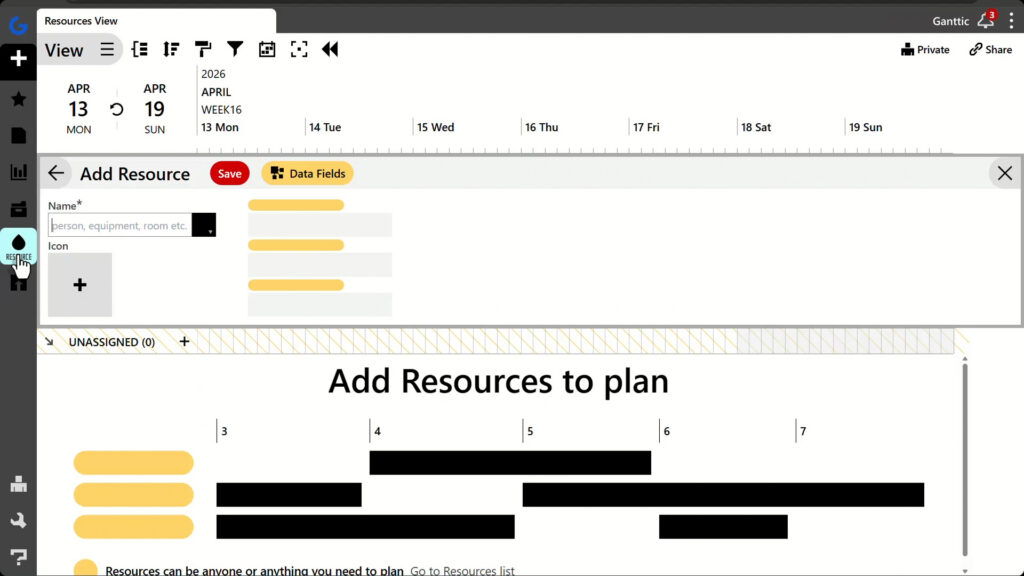 In Ganttic, you can add resources to your plan, be it a fleet, a piece of equipment, or a plant.
What broke was coordination between those offices. Outlook calendars and Excel could show a technician’s week, but neither could say whether the inspection rig that job needed was already committed to a pipeline in another state.
The team set two conditions for a replacement: real-time updates, and simple enough that technicians in the field would actually use it. Finding the right planner was just the first step. The second one was to make the team actually use it.
After a research period, they chose Ganttic because a cloud planner met both at once, where their existing tools met neither. Rollout began with 60 people who were sent usernames by email and came back with almost no questions. The process was as straightforward as the planner itself.
Pure Technologies now tracks at least 80 pieces of equipment in real time across Canada, Mexico and the US, a count it had written off as impractical.
Custom Data Fields on projects and on individual tasks carry each machine’s routing and condition detail.
The schedule goes out monthly showing where every machine and technician will be, so when one job slips the team can see what it strands downstream and reroute. All 8 managers work the plan at once, with edits appearing on each other’s screens instantly.
Fraser Magic 4WD: A hire fleet off paper
Fraser Magic 4WD has rented four-wheel drives out of Hervey Bay, Australia since 1992, for an island where conditions are harsh enough to demand an extraordinary amount of vehicle maintenance. Matt Scheller planned all of it on a paper agenda, with three staff and eight vehicles. Office calendars were designed around individuals rather than resources, and project tools were too complicated to set up.
The paper agenda was already tedious at three staff and eight vehicles, and it never answered the question that decides a hire company’s year: which weeks the fleet actually earns.
The team went looking for a computer-based calendar and ruled out spreadsheets from the start. Office calendars turned out to be built for scheduling individuals rather than resources, and project tools were too complicated to set up.
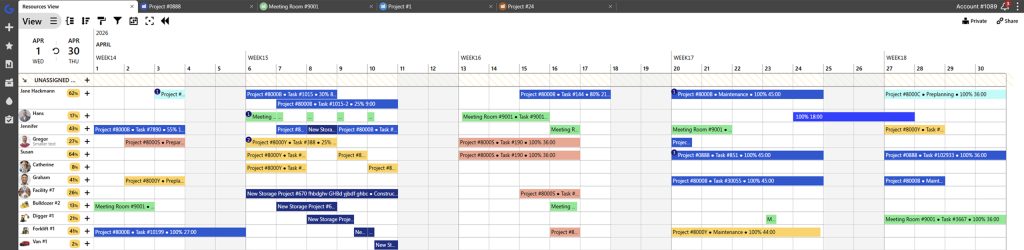 Ganttic is a straightforward and a flexible resource planner for teams scheduling people, equipment, or both.
Ganttic got the trial for two reasons: it was free for a limited number of resources with no time limit, and it looked straightforward, unlike the other complicated tools they saw during their initial research.
Each of the 20 vehicles now carries its status, location, bookings, repairs, and the barge and permit bookings that travel with every hire, alongside staff hours and holidays.
A forgotten or wrong booking has become rare, and the workshop schedules repairs against real demand instead of guesswork, reallocating by drag and drop when a hire moves.
The reports are what turn it into a utilization tool: Fraser can compare resource use across previous years, which is how a seasonal operator finds out whether 20 vehicles is the right number or two too many. Four staff enter bookings, three check daily tasks, and anyone off site opens the mobile app on Android and iOS.
G. Christianson Construction: 40 projects, one calendar
G. Christianson Construction builds and remodels homes around Corvallis, Oregon. Four superintendents ran more than 40 active projects through CoConstruct, Google Calendar, Monday and a shared spreadsheet, and none of it showed how one job’s claim on crew and machinery hit the next.
The timeline is the interesting part.
They trialed Ganttic in 2018 and passed, deciding it was not the right fit. Then the pandemic brought more work and sharply higher costs, with lumber up over 200% on some projects between signing the contract and starting the build, while the company was booking a year out across more than 40 jobs.
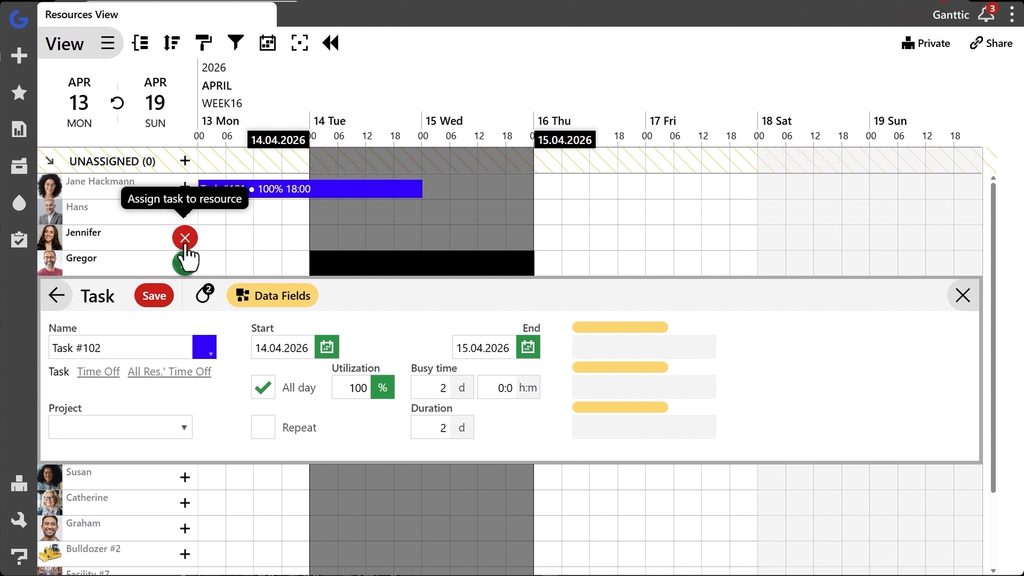 In Ganttic, you can easily assign Tasks and Projects to your Resources on the timeline.
Superintendent Tanner Wood compared running that on four tools to building a grand piano with a hatchet. Four years after the first trial, new Ganttic features plus a workflow that had stopped working brought them back.
This time Ganttic’s support team onboarded the superintendents directly, setting up project templates with tasks pre-assigned to subcontractors, color coding and Kanban boards by superintendent, Views that show the whole company or one project, and task dependencies to hold the build sequence.
CoConstruct and Google Calendar went entirely and Monday was reduced to CRM duties. Four months in, data entry had halved, four scheduling tools had become one calendar, and the team could schedule months ahead against each crew’s weekly work hours without overbooking the carpenters or the cabinet shop.
Valmet: Caught between a spreadsheet and an ERP
Valmet supplies technology and services to the pulp, paper and energy industries. Markus Kohl described a familiar bind: spreadsheets were too thin to manage resources properly, while MS Project and the company ERP were heavy, awkward to reach and not built for the web. Nothing covered the middle.
Markus Kohl described the bind as spreadsheets too thin to count as resource management, while MS Project and the company ERP were too complicated and not built for the web. They needed something easy to use and available anywhere, including on a phone. Nothing they already owned covered that middle ground.
Ganttic is where they landed, and the switch itself is the part worth noting.
Rolling a new planner into daily use across 12,000 people, spread over maintenance outsourcing, mill improvements and spare parts, would normally begin with a training program.
Kohl’s verdict was that nobody needed special training and no one went through tutorials. Once the plan was online where everyone who needed it could open it, overbookings and miscommunication dropped sharply, and managers could finally see how resources were divided across projects rather than inside each department’s own file.
What your asset utilization rate is really measuring
The asset utilization rate is productive hours over available hours. Most teams argue about the top number. The bottom one is where the distortion comes from, because available hours and calendar hours are not the same thing, and the gap between them looks different in every business.
Each of the four above shows a different version of it.
Pure Technologies has equipment shipping in from anywhere in the country, so transit and routing come out of the year before an inspection starts.
Fraser Magic 4WD’s island conditions demand an extraordinary amount of maintenance, which makes workshop days a standing deduction rather than bad luck.
At G. Christianson the ceiling is the crew’s weekly work hours and the build sequence, since a machine on site cannot work until the foundation ahead of it is finished.
Valmet shows the fourth version: the hours existed, but a shared denominator did not, and each department measured capacity inside its own file.
Measure against raw calendar time and every machine looks idle. Ganttic’s utilization reporting reads the same resource records that carry status and maintenance, which is what makes longer-term capacity planning worth doing.
See it on your own fleet
Ganttic charges per resource rather than per user, so everyone who needs the plan can open it. Check the pricing, book a demo, or start a free trial today!
FAQ
Divide the hours an asset was productively used by the hours it was genuinely available, then multiply by 100. Leave scheduled maintenance, calibration and transit out of the denominator. Measured against raw calendar time, equipment utilization understates every machine you own.
It depends on the asset. Hire fleets chase high numbers because an unbooked vehicle is lost revenue. Specialized inspection equipment often runs lower by design, since readiness is the point. Compare an asset against its own history first.
Yes. Both are resources in the same planner, which is how Pure Technologies tracks technicians and 80 pieces of equipment at once. Pricing is per resource, so adding people who only view the plan costs nothing. See resource-based vs user-based pricing.
Not always. G. Christianson dropped two scheduling tools and kept Monday for CRM work. Ganttic covers the middle ground Valmet described, between a thin spreadsheet and a heavy ERP. The resource planning guide walks through the decision.
Yes of course! We offer 14-day free trial with all the features included.